
AI Owns the Innovation Pipeline Now. CES Just Makes It Visible.
What CES 2026 quietly tells you about who actually controls the future
Philip Mordecai, CEO
[8 min read]
Every January, Las Vegas fills up with the future.
CES arrives. Screens glow. Robots smile. Someone declares a breakthrough that sounds like it came from a pitch deck written at altitude. For a few days, it all feels inevitable. Like progress has momentum. Like innovation is alive and well.
Then everyone flies home.
Most of what made the headlines never shows up again. No product. No adoption. No habit. Just a trail of clips, demos and optimism that slowly evaporates.
That’s usually where the story stops. It shouldn’t.
Because CES isn’t where innovation succeeds. It’s where it sheds parts into tiny fragments. Money wasted ? Perhaps, but it’s deeper than sales only. It’s cultural and it’s all about product and commercial momentum.
CES is where ideas go to break. That’s the point.
CES isn’t a factory. It’s a stress test.
Most ideas don’t survive contact with reality. They’re too expensive. Too fragile. Too early. Or they’re solving problems no one wakes up thinking about. That isn’t failure. It’s filtration.
Every idea that dies leaves something behind.
A component that gets cheaper.
An interface that becomes familiar.
A behaviour that stops feeling strange.
I’ve watched this pattern repeat for years. The wearables boom that fizzled a decade ago didn’t disappear. It quietly became today’s health platforms. The “smart fridge” everyone mocked didn’t change kitchens, but its underlying sensing and connectivity now run logistics systems most people never see.
Innovation doesn’t arrive in waves. It leaks. CES just happens to be loud about it.
For SMEs, the lag isn’t the risk. It’s the advantage.
If you run or back an SME, CES probably feels distant. The tech looks half-baked, overpriced, or completely disconnected from how work actually gets done.
That instinct is usually right.
Most frontier technology takes five to seven years to become cheap enough, stable enough and boring enough to matter. Cloud followed that path. Analytics followed it. AI is on it now.
The mistake isn’t waiting.
It’s waiting without preparing.
The organisations that consistently outperform don’t chase demos. They use the lag to learn the language, clean up their data, clarify decision rights and work out where value would actually land if the technology ever became usable.
By the time it does, they’re not excited. They’re ready.
CES is free reconnaissance. You don’t go to buy. You go to notice which futures are being sold, then work backwards to what might realistically touch your business later.
Now look at the plumbing. This is where control shows up.
If CES is where ideas get noisy, patent systems are where they get locked in. And this is where the tone shifts.
Across the US, UK and Europe, filings haven’t collapsed. If anything, they’ve held steady or grown. But the shape of innovation has changed.
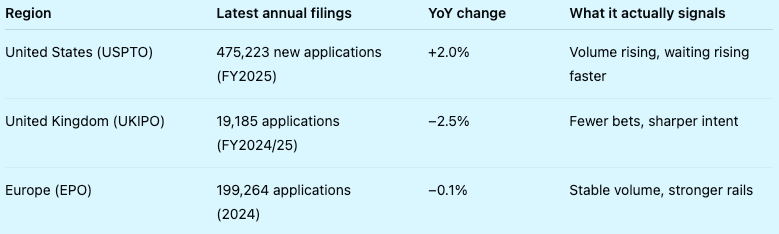
Florido US-UK-EU New Patents Comparison 2024-25, sources: https://www.uspto.gov/sites/default/files/documents/USPTOFY2025AFR.pdf , https://www.gov.uk/government/publications/the-patent-office-annual-report-and-accounts-2024-to-2025/the-patent-office-annual-report-and-accounts-2024-to-2025 , https://www.epo.org/en/news-events/press-centre/press-release/2025/1352247
Nothing here screams collapse. But it does point to something quieter and more important.
In the US, scale matters more than ever. In the UK, selectivity is rising. In Europe, structure is quietly improving. For SMEs, the real question is no longer “are we innovative?” It’s “Can we survive the system our innovation enters?”
The queue tells the truth that most people miss
In the US alone, more than 830,000 patent applications are sitting unexamined. Large organisations can absorb that. They plan for it. They layer continuations. They spread risk.
Most SMEs can’t. This doesn’t slow innovation. It reshapes it. It rewards endurance over originality, process over spark.
Pause here. This isn’t a warning shot. It’s a reset.
If AI is becoming infrastructure, it means the rules are settling. And when rules settle, disciplined operators tend to do well.
Where AI is actually going (and it isn’t the demos)
AI isn’t just growing. It’s dissolving into everything.
At the European Patent Office, AI-related filings have grown at roughly 28% a year since 2019, with continued growth through 2024. Computer technology is now the single largest filing category.
That matters less because it’s impressive, and more because it’s boring.
AI is no longer the product. It’s the layer underneath.
The CES demos make it feel flashy. The patents tell a quieter story. AI is embedded into diagnostics, energy systems, manufacturing workflows, logistics and security. The stuff that doesn’t trend, but compounds.
Zoom out again. This isn’t just a Western issue.
Globally, patent filings reached roughly 3.7 million in 2024. Asia continues to dominate volume.
That doesn’t mean the West ran out of ideas. It means innovation now lives inside systems that reward patience, scale and legal stamina. What does this mean in simple terms - If you’re investing, IP risk isn’t just technical anymore, it’s structural.
How CES actually turns into SME reality
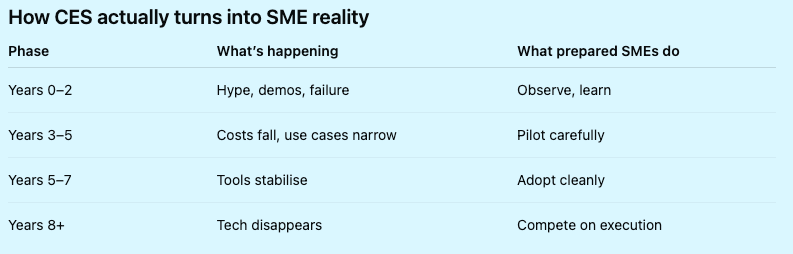
Source: Florido - estimated average time lag to market
The lag isn’t dead time.
It’s preparation time.
If you’re not ready for a full strategy review, start smaller. After CES, write down the three technologies that made you uneasy, not excited. Discomfort is often a better signal than hype.
So where do you actually sit?
Most leadership teams fall into one of three patterns.
The Spectators
They watch CES, share articles, and wait for certainty.
They usually miss the window.
The Sprinters
They chase early adoption and learn in public.
They often pay for it twice.
The Architects
They track signals early, prepare quietly, and move when the economics line up.
They’re rarely first. They’re often hard to catch.
Only one of these compounds has been studied over time.
A reality check from the field
One mid-market industrial business I worked with didn’t rush into AI tooling. Instead, it cleaned its data, clarified who made which decisions, and waited.
When AI-enabled maintenance software became affordable a few years later, adoption took weeks, not months. The savings were real. Competitors were still debating pilots.
That wasn’t luck. It was readiness.
The post-CES innovation playbook, without romance
CES will keep getting louder. AI will keep improving. Filing queues will keep growing.
So the work shifts:
File fewer, stronger patents.
Protect the business model, not the science fair.
Use acceleration only when timing actually matters.
Anchor AI claims in real technical change.
Treat interoperability and sustainability as default, not garnish.
Innovation isn’t about being first anymore; it’s about being ready when imagination turns into infrastructure.
Control beats prediction
CES 2026 will fade. Most demos will fail. Attention will move on.
What won’t fade are the second-order effects: cheaper components, normalised behaviour, quiet defaults baked into tools everyone ends up using.
The leaders who win won’t be the ones chasing stage lights in Vegas.
They’ll be the ones who prepared during the noise and moved when it stopped. And the ones who didn’t will struggle to explain what they lost, because it won’t disappear all at once.
It will just stop being available.
“The goal isn’t to patent everything. It’s to protect the few things that make you hard to copy, easy to fund and expensive to fight.”
To Conclude: If CES 2026 left you with more questions than answers about where innovation is actually heading for your business, that’s the work I spend my time on. For SMEs, innovation rarely fails because of ideas; it often fails because of timing, structure and control.
🟪 Philip Mordecai, Founder & CEO, Florido
I work with founders, boards and operators to help SMEs translate innovation signals into decisions that hold up when conditions tighten. Want a clearer view of where advantage is actually forming in your business?