
The Leadership Decision: Fractional vs Interim vs Full-Time (2026 Edition)
The Leadership Matrix: Why SMEs are Choosing "Agile Experts" to Navigate 2026
[4 min read]
The 2026 Reality Check
As we move through 2026, the SME "playbook" has fundamentally changed. The UK economy is cooling (with growth forecast consensus of 1.2% in 2026, rising from 0-1% in 2025), and the "fiscal drag" from frozen tax thresholds and higher National Insurance Contributions (NICs) is hitting balance sheets hard.
For an SME, the biggest risk isn't just the economy, it's leadership inertia. Hiring the wrong way in 2026 can lock you into high overheads precisely when you need to stay light on your feet.
Comparing the "Big Three": Which Model Fits Your 2026 Strategy?
Navigating this year requires a surgical approach to talent. Here is how the three main leadership models stack up in the current climate:
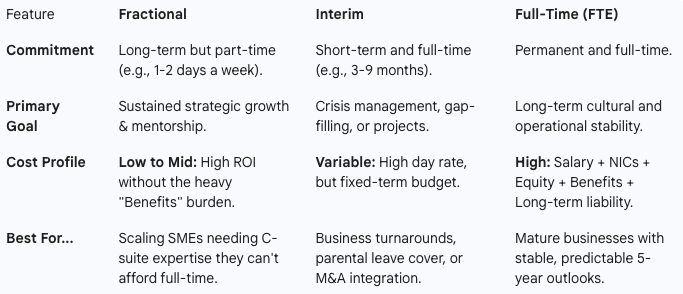
The three main leadership models for SMEs
Navigating 2026 Macro Headwinds: The Florido "Flex" Strategy
The "Headwinds" of 2026; rising employment costs, AI-driven restructuring and supply chain volatility, require a new kind of response.
Here is how Fractional and Interim services act as your "Economic Shock Absorbers":
1. Offsetting the "Employment Tax" Burden
With the impact of the Autumn Budget measures fully realised in 2026, the true cost of a permanent £100k+ executive is often 30–40% higher than the base salary when you factor in NICs and overheads.
The Agile Move: Using Fractional Leaders allows you to "access" that £100k+ brain for a fraction of the cost, keeping your permanent headcount lean while maintaining high-level output.
2. Solving the AI & Digital Transition Gap
2026 is the year AI moves from "hype" to "infrastructure." Most SMEs don't need a full-time Chief AI Officer, but they do need someone to oversee the integration of automated workflows to save costs.
The Agile Move: An Interim Digital Transformation Director can build your 2026 tech stack in six months and then exit, leaving your team upskilled without a permanent salary line.
3. Resilience in a "Cooling" Economy
KPMG and the OBR suggest 2026 will be a year of "subdued" growth. In this environment, long-term employment contracts can become a liability if market conditions shift suddenly.
The Agile Move: Flexible leadership models allow you to scale your leadership "spend" up or down. You can increase a Fractional CFO's days during a funding round and scale back once the cash is in the bank.
4. Securing Governance and Preserving Culture (The Transition Bridge)
During periods of vacancy or structural change, the "culture gap" is where SMEs lose their best people. Interim leaders do more than fill a seat; they act as a "Governance Bridge," ensuring compliance and stability during 2026's shifting regulatory landscape.
The Agile Move: An Interim Leader provides a neutral, steady hand to preserve organisational culture and maintain high governance standards while you search for the perfect long-term fit, preventing "leadership vacuum" rot.
5. Boosting Board and Investor Confidence
In a tighter 2026 capital market, investors are looking for "Adults in the Room." Bringing in a high-calibre growth engine or strategic expert—even for a defined period—signals to your Board and stakeholders that you are serious about professionalising your strategy.
The Agile Move: Deploying a Fractional Strategy Director provides the sophisticated reporting, market analysis and growth-mapping required to secure your next round of funding or satisfy an inquisitive Board of Directors.
The 2026 Leadership Cost Analysis: FTE vs. Agile Experts
In 2026, the gap between a "Salary" and the "Total Cost of Employment" has never been wider. For an SME, hiring a permanent C-suite leader is no longer a simple payroll decision; it is a significant capital commitment.
Below, we compare the financial impact of a typical Director-level hire (£120k base) across the three primary models.
Comparative Cost Table (2026 Estimates)

¹ Based on an average 2026 day rate of £1,200 for strategic C-suite roles. ² Based on 5 days/week at £1,000/day for a high-intensity transition period. ³ Calculated using the 2026 15% Employer NIC rate and the lowered £5,000 secondary threshold.
Strategic Commentary: Why the Numbers Matter
The "Hidden" 43% Premium
For a permanent hire, the "Total Commitment" is roughly 43% higher than the base salary in Year 1.
In a cooling 2026 economy, this "Day 1" cost can drain the very runway you need for growth. By contrast, Fractional leadership removes the recruitment and tax friction entirely.
Hedging Against 2026 Headwinds
The NIC Shock: With Employer National Insurance rising to 15% and thresholds dropping to £5,000, permanent headcount is your most expensive asset. Fractional and Interim models allow you to buy "Results" as a service, not "Liability" as a cost.
Investor Readiness: If you are preparing for a funding round in late 2026, a Fractional C-suite provides the sophisticated reporting and "Board-grade" confidence investors demand, at approximately 1/6th the cost of a permanent hire.
Governance during Vacancy: If you lose a key leader, the cost of an "Empty Chair" is often higher than the fee for an Interim Director. An interim hire secures your culture and keeps governance standards high while you find a permanent solution at a measured pace.
The Florido Verdict: Move from "Payroll" to "Access"
In 2026, the most successful SMEs won't be those with the largest offices or the biggest permanent teams. They will be the ones with the most flexible access to intelligence.
Whether you need the steady, part-time hand of a Fractional CEO to optimise your margins, or an Interim Management Director to navigate new 2026 employment regulations, Florido is your bridge to that expertise.
Stay tuned. Keep your finger on The Pulse.
Is your current leadership structure a driver of growth or a drain on capital?